
Hey babe, have you also been putting together your Hong Kong travel checklist lately? Steaming hot shrimp dumplings and siu mai, the neon signs in Causeway Bay that glow deep into the night, the evening breeze over Victoria Harbour, and the roller coasters at Ocean Park — just thinking about all that makes you want to book a high-speed rail ticket right away. So many friends around me are picking Hong Kong as their first stop for a short cross-border trip: some go there specifically to hit the malls for shopping sprees, while others wander the streets and alleys to dine at time-honored eateries, packing their itineraries to the brim.
But after reading numerous posts shared by experienced travelers, I realized that many people run into payment-related pitfalls only after arriving in Hong Kong: they can’t figure out the fluctuating exchange rates at currency exchange outlets, worry about losing or having their thick wad of cash stolen, are unsure whether small shops accept QR code payments, and hesitate to withdraw cash for fear of exorbitant fees — these trivial little things always end up spoiling what should have been a wonderful trip.
So to make my upcoming trip to Hong Kong go as smoothly as possible, I’ve done a thorough deep dive into all the commonly used local payment methods, and sorted out everything clearly: what scenarios each method suits, how convenient it is to use, and whether the fees are high. Today I’m sharing this complete guide with you, so you can set off without a single worry after reading it.
I. List of Mainstream Payment Methods in Hong Kong
Hong Kong’s payment ecosystem is mature and diverse, and it is also very friendly to mainland tourists. Different scenarios correspond to different optimal payment methods, and choosing the right core tool will ensure a smooth journey throughout. To make it clear at a glance, I have sorted out the main payment methods into the following table:
| Payment Method | Key Features | Applicable Scenarios | Representing Platforms / Institutions |
|---|---|---|---|
|
Bank Card Payment
|
It boasts wide acceptance across networks, supports both consumption and cash withdrawal, and ensures secure large-value transactions with proper supporting records.
|
Shopping malls, hotels, restaurants, ATM cash withdrawal
|
UnionPay, Visa, Mastercard
|
|
local e-wallet
|
Mobile payment is convenient and covers daily retail and lifestyle services.
|
chain stores, convenience stores, wet markets, catering services, and online payment services
|
AlipayHK、WeChat Pay HK
|
|
Octopus
|
Contactless card tapping payment, with high adaptability to transportation scenarios
|
public transport, convenience stores, fast food restaurants, small-scale retail
|
Octopus Cards Limited
|
|
Hong Kong Dollar cash
|
Threshold-free adaptation, capable of covering niche scenarios
|
street-side stores, traditional merchants, and small-sum emergency reserves
|
–
|
II. Detailed Explanation of Full-Scenario Payment Methods in Hong Kong
Below, based on the four most common consumption scenarios encountered by mainland tourists, we will respectively explain the usage and features of different Payment Instruments, and you can directly refer to them in light of your own itinerary.
(I) High-value consumption scenarios: shopping at malls, hotel check-in, and formal dining
Such scenarios involve large amounts and have high requirements for transaction security, so bank card payment is the preferred option as it comes with complete vouchers and clear settlement.
1. UnionPay Cards: The Preferred Payment Method for Mainland Tourists
UnionPay cards enjoy comprehensive acceptance network coverage in Hong Kong, and can be used at almost all merchants. The UnionPay cards that are commonly used in daily life on the Chinese mainland can basically be directly used when going abroad, with no need to apply for a new card additionally, thus minimizing the preparation cost before departure.
- Transparent settlement with no extra costs: When making purchases via the UnionPay network, the HKD amount is directly converted into RMB for posting at the market exchange rate, without any intermediate US dollar conversion, no secondary exchange, and no additional currency conversion fees. You can simply repay the RMB bill directly after returning to China, with a clear and itemized statement.
- Full coverage of all merchant categories: It covers over 3,000 selected premium stores including renowned F&B merchants in Lan Kwai Fong and New Town Plaza, local specialty restaurants such as Tao Heung Group, entertainment venues including the ticketing office of the Hong Kong Airport Express, local travel agencies and Ocean Park, as well as various accommodation options ranging from boutique guesthouses to five-star hotels. For a small number of merchants that do not display the UnionPay logo, you may proactively present your card to inquire about payment acceptance.
- Flexible and diverse payment forms: In addition to traditional physical card insertion and card swiping payment, it also supports two types of mobile payment forms, namely UnionPay Mobile Pay and Cloud Flash Payment QR code. UnionPay Mobile Pay covers mainstream mobile phone brands including Apple, Huawei, Honor, Xiaomi, OPPO, vivo and Samsung. After binding a UnionPay card, users can complete contactless payment by simply holding the phone close to a POS terminal, which fits the mainstream payment habits overseas; it can be quickly activated for small-value payments for higher efficiency.The Cloud Flash Payment QR code is also compatible with all types of merchants. When using it outside Chinese Mainland, you need to enable mobile phone location services or manually switch to the “Non-Chinese Mainland Payment” mode in the upper right corner of the payment code.
- Dual-logo card renewal and upgrade with unchanged benefits: The UnionPay-Visa dual-logo card that has completed the free chip upgrade enjoys all the benefits of a single-logo card, supports both contact and contactless payment methods, is compatible with domestic UnionPay network, overseas UnionPay network and overseas Visa network, and the chip-level protection further enhances card usage security. When making purchases with a dual-logo card, you may proactively request the cashier to select the UnionPay network to enjoy corresponding services and discounts; some acquirers will submit transactions via the default routing, and the final transaction network shall be subject to the actual result.
2. Visa / Mastercard: An Internationally Accepted Payment Option
As international card organizations, Visa and Mastercard are widely accepted by merchants in Hong Kong and are suitable for travelers holding corresponding cards. Visa covers more than 200 countries and regions worldwide, while Mastercard covers more than 210 countries and regions globally, and both are commonly supported in scenarios such as shopping malls, hotels and chain restaurants in Hong Kong. Such cards usually use the US dollar as an intermediary for settlement, and some card issuers will charge a certain percentage of currency conversion fee, with specific rules subject to the corresponding card-issuing institution.
(2) Daily small-amount consumption scenarios: convenience stores, wet markets, and casual food shops
Such scenarios are characterized by high frequency and small transaction amounts, place greater emphasis on payment convenience, and have a wider range of optional Payment Instruments.
1. UnionPay Mobile Payment: No extra registration required, ready to use anytime
For small daily purchases like buying bottled water or snacks, using UnionPay mobile Pay or Cloud Flash Payment QR codes is extremely convenient. There is no need to pre-load funds or register a separate local account — you can simply link your regularly used UnionPay card to get started, which aligns with the usage habits in the Chinese mainland and involves no learning curve whatsoever.
2. Local e-wallets: Adapted for local lifestyle services
There are several commonly used e-wallets in Hong Kong. Apart from in-store payments, they also support local lifestyle services such as bill payment and money transfer, so tourists with relevant needs can choose whichever suits their needs.
- AlipayHK: A licensed e-wallet regulated by the Hong Kong Monetary Authority, it is accepted by over 150,000 retail merchants across Hong Kong, covering scenarios including large chain stores, convenience stores, supermarkets, wet markets and restaurants, while featuring functions such as transport payment, cross-border payment, utility bill payment, e-commerce shopping and digital coupons.
- WeChat Pay HK: It is a HKD wallet service backed by WeChat accounts, which can be activated by registering with a Hong Kong mobile phone number. It supports online and offline merchant consumption in Hong Kong, Macao, the Chinese mainland and Japan, with transactions automatically converted at exchange rates and settled in Hong Kong dollars. It also features functions such as utility bill payment, electronic red envelopes, fund transfer, and mainland e-commerce shopping, and its supporting WePoints points can be redeemed for merchant coupons.
(III) Public transport scenarios: MTR, buses, ferries
Transport payment is a scenario of high-frequency inelastic demand, and different tools are adapted to corresponding travel frequencies respectively.
1. UnionPay Payment: Also Applicable in Transportation Scenarios
The ticket offices of the Hong Kong Airport Express support UnionPay card swiping, Cloud Flash Payment QR code scanning and UnionPay mobile Pay payment. It is extremely convenient to purchase tickets both when arriving at and departing from the airport, and there is no need to apply for a transportation card in advance just for a single trip.
2. Octopus: A commonly used tool for local transportation
Octopus is a contactless smart card payment system developed early in Hong Kong, officially launched in 1997, and is also one of the commonly used Payment Instruments for local residents. It can be used on all public transport including MTR, buses and ferries, with payment completed simply by tapping the card, and it also supports consumption at small retail outlets such as convenience stores and fast food restaurants; access control systems of some commercial and residential buildings are also compatible with it. Currently, Octopus services cover around 98% of Hong Kong residents, processing approximately 15 million transactions per day. Visitors can purchase the corresponding card type for use, and process card refunds in accordance with relevant regulations upon departure.
(IV) Emergency Backup Scenario: Street-side Shops and Traditional Merchants
Even with the widespread popularity of electronic payments, there are still a few niche scenarios where cash is a more suitable option to serve as a backup for travel needs.
Having a small amount of Hong Kong dollar cash as a reliable emergency backup is a smart move, as some street food stalls, time-honored traditional shops and niche local markets prefer cash payments, so carrying a small sum of HKD will make your trip more hassle-free. If you run short of cash, there is no need to seek out a currency exchange booth specifically — you can simply withdraw money directly from street-side ATMs using a UnionPay card.
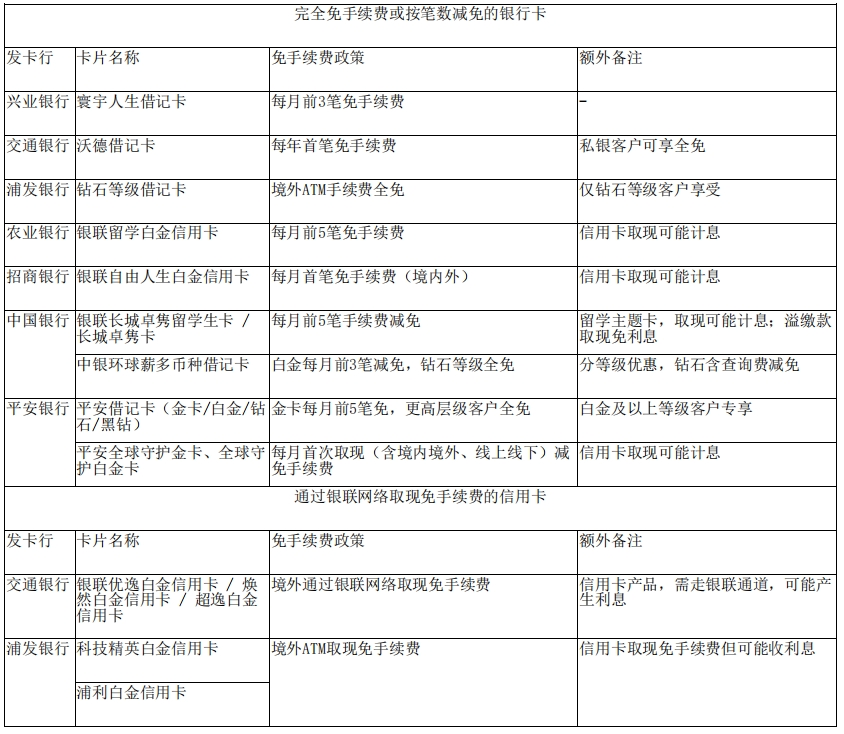
Almost all ATMs in Hong Kong support UnionPay cards for Hong Kong dollar cash withdrawal, and all are equipped with Chinese interfaces, which can be easily found around airports, commercial districts and convenience stores. The cash withdrawal fee consists of two parts: the fee charged by the card-issuing bank and the service fee charged by the local ATM institution. UnionPay itself does not charge any fee for overseas cash withdrawal, and some card types are eligible for waivers on card-issuing bank fees, making the overall cost manageable.
UnionPay cards that partially support fee-free cash withdrawal overseas for reference:
III. Important Reminders for Travel Payment
After learning about the payment methods applicable to various scenarios, there are several practical details worth noting, which can help you avoid unnecessary costs and troubles.
- Dynamic Currency Conversion Risk: When making a card payment at a merchant or withdrawing cash from an ATM, if a prompt such as “Settle in RMB” or “Convert to RMB” appears, it is recommended to decline the option and insist on transacting in HKD to avoid extra costs arising from exchange rate differences.
- Cash Withdrawal Fee Confirmation: Some ATMs charge additional service fees, which are collected by local institutions and have nothing to do with UnionPay and the card-issuing bank. Please pay attention to the on-screen prompt before withdrawing cash and proceed only after confirming that the information is correct.
- Card Usage Safety Reminder: Please shield your PIN when entering it, keep your card in sight during card swiping, and contact the card-issuing bank immediately to report a loss if your card is lost.
- Regulatory Limit Notice: Overseas cash withdrawals using domestic bank cards are subject to regulatory limits. The daily cash withdrawal limit per card is the equivalent of 10,000 RMB, and the annual total limit is the equivalent of 100,000 RMB. Please plan reasonably according to your itinerary before your trip.
IV. Suggestions for Travel Matching for Mainland Tourists
For mainland tourists, prioritizing the use of their regularly used UnionPay cards to cover core consumption is the most cost-effective and hassle-free solution. For large expenses such as shopping at malls, hotel check-ins, and formal dinners, simply swiping a UnionPay card or paying via UnionPay Mobile Pay allows for clear and worry-free RMB settlement; for small-value, high-frequency scenarios like convenience stores and casual eateries, both Cloud Flash Payment QR codes and UnionPay Mobile Pay are highly convenient; if you frequently take public transport, you can additionally prepare an Octopus card to boost travel efficiency; keeping a small amount of Hong Kong dollar cash on hand for niche scenarios such as street-side shops will basically cover all your needs throughout the trip.

Final Notes
Back when we were planning our trip to Hong Kong, we were utterly captivated by the cha chaan tengs and the night views of Victoria Harbour on the screen, already daydreaming about strolling down Nathan Road in person and sinking our teeth into a freshly baked pineapple bun. The magic of travel lies precisely in these little, everyday moments of warmth, and it should never be spoiled by the hassle of currency exchange, transaction fees, or the awkward predicament of being unable to pay.
Get the trivial matter of payment sorted out in advance: bring the UnionPay card you use on a daily basis, familiarize yourself with where you can tap it, where you can withdraw cash, and how to operate it to get the best value, then prepare an Octopus card as needed for transportation, and you can devote all your remaining attention to the scenery. There’s no need to clutch cash and repeatedly calculate the exchange rate, no need to hunt around for currency exchange points; you can shop at malls with peace of mind by swiping your card, scan a code on the spot to buy street-side milk tea, and just head to an ATM to withdraw a small amount of cash whenever you need it — a smooth payment experience will add a touch of relaxed confidence to this long-awaited trip to Hong Kong.
Disclaimer: Exchange rates fluctuate in real time, and the actual rate at the time of transaction shall prevail; for specific preferential activities, merchant acceptance status and handling fee policies, please refer to the official website of UnionPay International, Cloud Flash Payment App, prompts on local terminal screens and official announcements of respective Payment Instruments.